Postcard from MWC Shanghai 2026: Beyond Connectivity
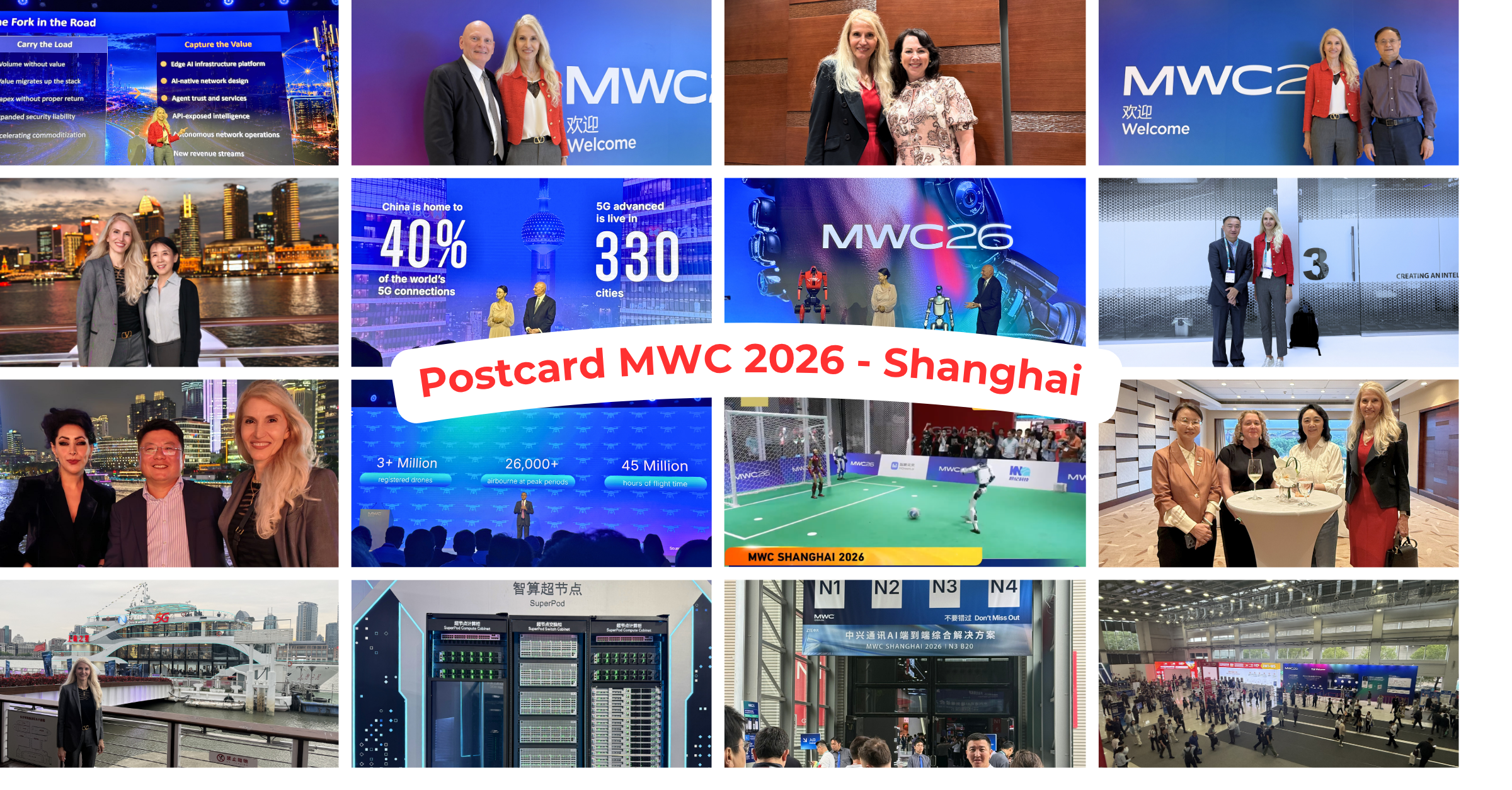
Embodied AI came to life in Shanghai.
At MWC Barcelona this spring, the conversation was about the idea of the AI agent era: AI agents, AI-native networks, and the architecture the next era would require.
In Shanghai, those ideas felt physical, commercial, and close to deployment.
AI was showing up everywhere, in networks, devices, robots, industrial use cases, edge infrastructure, and entirely new economic models.
That was also the heart of my keynote, "Beyond Connectivity: Five Frontiers of the Intelligent Network," delivered in the Keynote 2 session "Infrastructure Reimagined: Intelligence at the Core," hosted by GSMA CMO Lara Dewar .
My message was simple: telecom has an opportunity to transcend connectivity, not just to benefit from the AI era, but to become a key contributor to it.
I framed the choice as a fork in the road.
One path is to carry the load: volume without value, capex without proper return, expanding security liability, accelerating commoditization.
The other is to capture the value: edge AI infrastructure, AI-native network design, agent trust and services, autonomous network operations, and new revenue streams.
Shanghai made the stakes of that choice impossible to ignore.
1. Five frontiers of intelligent infrastructure
AI-Native Networks Beyond data-driven: the intelligence imperative.
The industry has made enormous progress in analytics, automation, and data-driven operations. But the next step is not simply adding AI tools to existing workflows. It is architecting networks where intelligence is part of the design logic from the beginning.
AI-native cannot mean AI-added. In AI-added networks, automation follows instructions. AI-native networks pursue intent under governance.
Edge AI Intelligence has no fixed address.
As AI moves into real-world applications, not all intelligence can live in centralized clouds. Industrial AI, robotics, XR, autonomous systems, AI-enabled devices, and mission-critical applications will need intelligence closer to where action happens.
The edge is not just a latency story. It is a data privacy, sovereignty, cost, resilience, and user-experience story.
AI-RAN The radio access network as AI compute platform.
AI-RAN is still early, but the ambition is important: to treat the RAN not only as connectivity infrastructure, but as a potential distributed AI platform. That could change how operators think about network assets, workload placement, energy efficiency, and monetization.
The shift is already reaching the passive layer. At the show, China Tower joined the GSMA bringing 2.1 million tower sites and 5.6 million base stations that are being upgraded into intelligent edge-computing hubs — passive assets becoming AI platforms.
The imperative now is to move AI-RAN from pilot to production.
Agentic AI Networks as trust anchor for autonomous agents.
As AI agents begin to act on behalf of people, enterprises, machines, and applications, the trust layer becomes critical. Telecom has assets that matter: SIM and device binding, location consistency, behavioral signals, network-layer anomaly detection, and privacy-preserving brokerage.
The scale is not hypothetical. In Barcelona, one forecast put the world at roughly 100 billion AI agents by 2030. In Shanghai, Huawei projected hundreds of billions by the 2030s. Whatever the exact number, networks will soon serve vast populations of non-human actors.
And agents will not tolerate jitter the way humans do. Machine-speed QoS tiers, latency SLAs, dedicated slices for high-value agent traffic, and deterministic connectivity may become a new category of agent-grade services.
In other words: know your agent, serve your agent.
Tokens, Watts, Chipflation AI's shifting infrastructure economics.
The AI era is creating a new economic vocabulary. Tokens, watts, and chips are becoming as important as gigabytes, minutes, and megahertz.
For operators, this matters because AI workloads will create new infrastructure demands, new cost structures, and potentially new monetization models.
Architecture choices made today lock in economics for years.
2. Embodied AI moved from metaphor to main stage
One of the most memorable moments of MWC Shanghai was the opening ceremony, where john hoffman and 斯寒 Sihan Bo Chen were joined on stage by HONOR 's humanoid robots, Vita Boy and Flash.
Flash had just won the Beijing Yizhuang Humanoid Robot Half Marathon in April, completing the 21-kilometer course under autonomous navigation faster than the human world record.
It was theatrical, but it was not just theater.
The humanoid robots, the Humanoid Robot Football Penalties Challenge, and the broader robotics programming made a larger point: AI is moving from software into the physical world.
In his opening keynote, GSMA Director General Vivek Badrinath looked beyond robots to the wider "low-altitude economy", China alone now has more than 3 million registered drones, as another frontier where mobile infrastructure becomes the enabling layer.
That changes the network conversation.
Physical AI does not just need model intelligence. It needs sensing, mobility, real-time coordination, low-latency response, safety, trust, and reliable connectivity. It needs infrastructure that can support machines that perceive, decide, move, and act.
That is why Edge AI, AI-RAN, and agent trust are not separate topics. They are increasingly connected parts of the same architecture.
3. The uplink is becoming strategic
Another theme that stood out to me in Shanghai was the emphasis on uplink.
For years, mobile networks have been largely downlink-centric because human consumption patterns were downlink-centric: streaming, browsing, downloading. Social media and creator tools already increased the importance of uplink. The AI era will multiply it.
AI devices, industrial cameras, robotics, connected vehicles, XR, video generation, and machine vision create a world where more intelligence begins at the endpoint. Sensors, devices, and machines will generate richer upstream data. Some will be processed locally. Some will travel to edge compute. Some will reach cloud AI systems.
That makes uplink capacity, coverage, latency, and reliability much more strategic.
In the Chinese vendor showcases, uplink was treated less like an afterthought and more like a first-class design priority for Mobile AI. The discussion was not only about more bandwidth. It was about multi-antenna upgrades, spectrum coordination, device-network collaboration, and service assurance for AI-era traffic. One vendor framed high uplink as a defining capability of the token era — noting that AI glasses running real-time, multimodal translation already need on the order of 20 Mbps upstream.
The AI economy will not be served by yesterday's asymmetries. Intelligent infrastructure must support intelligence flowing in many directions.
4. From data plans to token economics
One of the more interesting signals from China is how quickly tokens are moving from an AI-developer abstraction to a consumer and enterprise service unit.
In May, China's three tier-1 carriers, China Telecom, China Mobile, and China Unicom, each unveiled token-based service plans, ecosystem alliances, and commercial pricing.
The demand behind it is staggering. Per China's National Data Administration, average daily token consumption jumped from around 100 billion at the start of 2024 to 140 trillion by March 2026, a more than 1,000-fold increase in two years!
This is early, and we should not overread any single plan. But the direction matters.
If mobile data plans helped define the smartphone era, token plans may become one of the experiments that define the AI services era. Tokens are becoming a consumable unit of AI value, something that can be packaged, priced, billed, optimized, and potentially bundled with connectivity, compute, identity, and service assurance.
That connects directly to the fifth frontier from my keynote: tokens, watts, and chipflation. It is also what the show's "IQ Era" framing looked like in practice, the industry describing a shift from byte economics to "byte + token" economics.
Operators understand usage-based business models. They understand metering, service tiers, quality of service, identity, billing, and large-scale infrastructure economics.
Done well, token economics could become more than a billing innovation. It could become a bridge between connectivity, compute, AI services, and trusted digital interactions.
China didn't invent the token. It invented the token plan.
5. The conversations that mattered
The best part of MWC is always the people.
I was grateful for the warm reception to my keynote, and for the thoughtful, generous feedback from GSMA and industry leaders afterward.
A special thank-you to Lara Dewar, the GSMA's Chief Marketing Officer, who hosted our keynote session. Lara has a rare talent for bringing the right people together around the questions that matter, and a generosity of spirit that makes these gatherings what they are. I'm grateful for her championing of this conversation.
I also had the pleasure of speaking with many thoughtful leaders, including Dr. Qi Bi , Chief Scientist of China Telecom and CTO of its Research Institute and a former Bell Labs Fellow; MING XIAO, President of Global Sales at ZTE, Sianne Ryder CEO of GSMA's Events and Industry Services, and Li Lixin, General Manager of China Unicom's device subsidiary, Unicom Huasheng.
The GSMA Shanghai Night and the Humanoid Robot Football Penalties Challenge Awards Ceremony aboard the Huangpu River cruise added another layer to the experience, part networking, part celebration, part reminder that this industry is at its best when it brings together technologists, operators, device makers, infrastructure leaders, and new communities of innovators.
I also had the chance to see the major equipment and ICT vendor showcases. I would not reduce those visits to any single demo. The larger signal was the convergence: networks, compute, devices, AI services, energy, and economics are becoming increasingly intertwined.
One More Thing: the endpoint is getting good eyes
Watching people shoot photos on the show floor, I noticed how good the cameras had become, the HONOR phones especially, with a lens so big it looks like a giant eye, and pictures to match. A small thing that points at a big one: the endpoint is getting good eyes.
The bigger pattern
I closed my keynote with five imperatives. After seeing the energy and direction of MWC Shanghai, they felt even more urgent.
Architect for AI-native, not AI-added.
Build the edge now, before the window closes.
Move AI-RAN from pilot to production.
Seize opportunities in the AI agent trust layer and AI agent services.
Discipline the economics: tokens, watts, and chips.
The direction of travel is clear. GSMA Intelligence data shown at the event put AI at roughly 20% of enterprise digital-transformation spend through 2030, ahead of 5G, cloud, cybersecurity, and IoT.
MWC Shanghai made one thing clear: the future of telecom is not simply about more capacity. It is about intelligent infrastructure that can sense, learn, adapt, authenticate, compute, and create new value.
Connectivity remains essential. But the opportunity ahead is bigger.
The next chapter is beyond connectivity.
A heartfelt thank-you to Vivek Badrinath , john hoffman , Lara Dewar , Sianne Ryder , 斯寒 Sihan Bo Chen , and the entire GSMA team for an energizing MWC Shanghai.