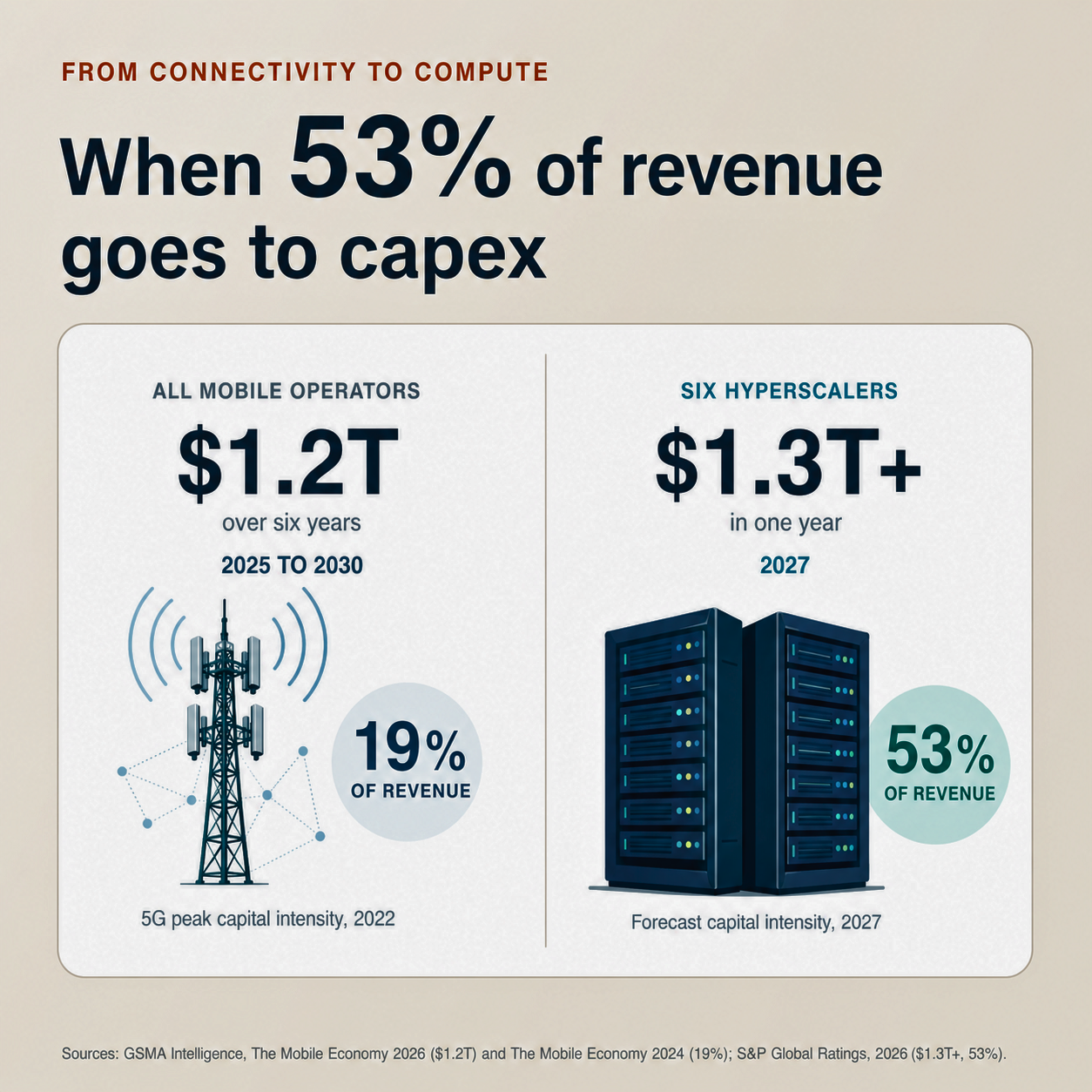
One year of capex by six hyperscalers will exceed six years of capex by all mobile operators worldwide.
One year of capex by six hyperscalers will exceed six years of capex by all mobile operators worldwide.
In research published last week, S&P Global Ratings estimates that Alphabet Inc., Amazon, Microsoft, Meta, Oracle and SpaceX will spend more than $1.3 trillion in 2027 alone.
By comparison, GSMA Intelligence's 2026 forecast puts worldwide mobile operator capex at approximately $1.2 trillion from 2025 through 2030.
Having spent much of my career in telecom, an industry known for massive network investments, I find that comparison remarkable.
The difference is not just the absolute dollars. At what GSMA Intelligence describes as the likely peak of the 5G investment cycle in 2022, global mobile capex reached 19% of revenue. S&P expects the six hyperscalers' capex-to-revenue ratio to reach 53% in 2027.
That is nearly three times telecom's capital intensity at the height of 5G.
This is not an argument that hyperscalers are spending too much. Demand for AI compute is real, and much of this investment will provide the foundation for new products, services and industries.
But the scale of the buildout is changing the character of these companies. S&P notes that they are moving beyond internally funded capex to greater use of debt, leases, joint ventures, special-purpose vehicles and residual-value guarantees.
AI compute is becoming heavy infrastructure.